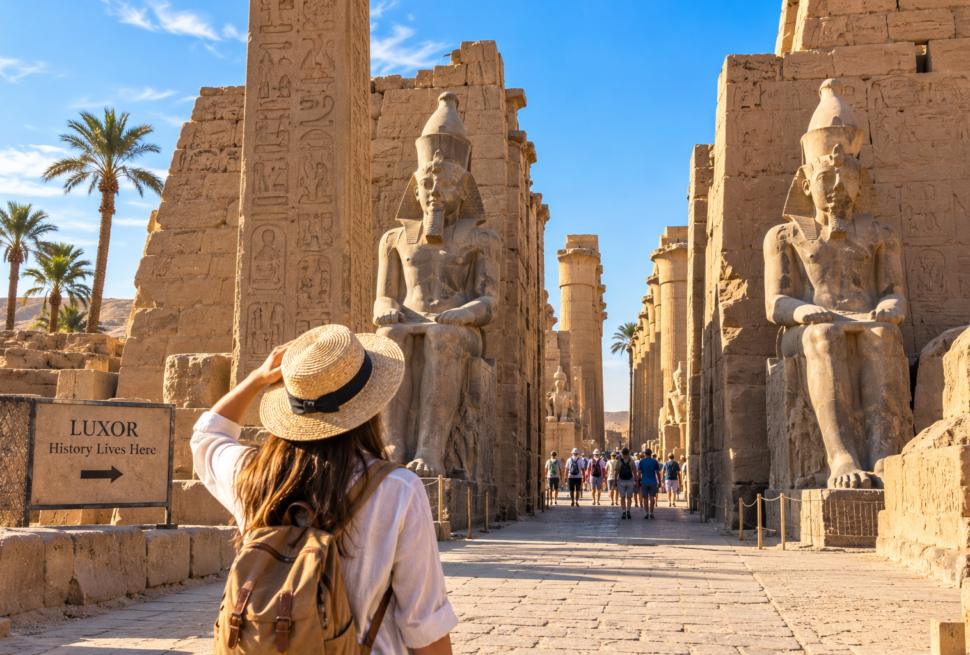
Ancient Egyptian art is one of the most recognizable artistic traditions in the ancient world. The paintings, reliefs, sculptures, and inscriptions preserved in temples and tombs provide valuable evidence about how ancient Egyptians represented people, nature, religion, work, and the world around them.
Much of what survives today is connected with temples and funerary monuments. These artworks were not created simply to decorate buildings. Images, colors, symbols, and inscriptions often had religious, social, or funerary meanings.
For visitors exploring Luxor, the decorated tombs of the west bank offer an opportunity to see this artistic tradition in its original archaeological setting.
What Makes Ancient Egyptian Art Different?
Ancient Egyptian artists followed established conventions that remained recognizable for thousands of years.
Human figures were often represented using a combination of different viewpoints. For example, the head and legs could be shown from the side while the torso was presented more frontally.
This was not necessarily an attempt to create a realistic portrait in the modern sense. Instead, artists followed conventions that helped communicate the identity, role, and characteristics of the person being represented.
The size of figures could also communicate status. Important individuals could be represented larger than people of lower social rank.
Art Was Connected With Religion
Religion played a major role in ancient Egyptian art.
Images of gods, kings, offerings, rituals, and the afterlife appear throughout temples and funerary monuments.
In tombs, paintings and reliefs could be connected with the deceased’s journey into the afterlife and with the religious beliefs surrounding death and rebirth.
This is one reason why ancient Egyptian art should be understood within its cultural and religious context rather than judged only by modern ideas of artistic realism.
What Do Tomb Paintings Show?
The decorated tombs of Luxor preserve a wide range of scenes.
Depending on the tomb and historical period, visitors may see representations of:
- Agriculture
- Harvesting
- Fishing
- Hunting
- Food preparation
- Animals
- Music and dancing
- Religious ceremonies
- Offerings
- Workers and craftsmen
- Family members
- Funerary rituals
These scenes can provide important evidence about ancient Egyptian society.
However, they should not automatically be interpreted as direct photographs of everyday life. Tomb decoration followed artistic and religious conventions, and the meaning of a scene depended on its context.
Ancient Egyptian Art and Daily Life
One of the most interesting aspects of Egyptian tomb art is the way it preserves details about society.
Painted scenes can show clothing, hairstyles, tools, agricultural activities, animals, food, musical instruments, and different occupations.
When combined with archaeological evidence from settlements and objects, these images help researchers investigate aspects of Ancient Egyptian daily life.
The evidence is especially valuable because many organic materials that once existed in everyday life have not survived, while scenes representing them may remain visible on tomb walls.
Scenes of Agriculture and Food Production
Agriculture was fundamental to ancient Egyptian society, and agricultural activities appear frequently in tomb decoration.
Scenes can include plowing, sowing, harvesting, threshing grain, transporting crops, and preparing food.
These representations help illustrate the importance of farming and food production within Egyptian society.
They can also provide information about tools, animals, workers, and agricultural practices, although each scene must be interpreted according to the specific tomb and its purpose.
Animals in Ancient Egyptian Art
Animals appear throughout ancient Egyptian art.
Cattle, birds, fish, dogs, cats, horses, crocodiles, and many other animals could be represented in different contexts.
Some images show animals as part of agricultural or hunting scenes, while others had religious or symbolic significance.
The detailed representation of animals is one of the features that makes Egyptian art particularly useful for studying aspects of the natural environment and ancient human-animal relationships.
Music, Dance and Celebration
Tomb scenes can also depict musicians, dancers, banquets, and social gatherings.
Musical instruments such as harps, flutes, drums, and other instruments appear in Egyptian artistic representations.
These scenes provide evidence for the role of music and performance in Egyptian society.
As with other tomb imagery, however, the scenes should be interpreted within the context of the tomb rather than assumed to represent ordinary entertainment exactly as it happened every day.
Clothing, Hairstyles and Appearance
Ancient Egyptian art preserves many details about clothing and personal appearance.
Men and women can be shown wearing different garments, jewelry, hairstyles, and accessories.
Because artistic conventions changed over time, these representations can also help researchers study changing fashions and social distinctions.
The combination of visual evidence with surviving archaeological objects provides a stronger basis for understanding ancient Egyptian appearance than paintings alone.
Colors in Ancient Egyptian Art
Color was an important element of Egyptian artistic expression.
Artists used mineral-based pigments and other materials to produce colors for figures, objects, clothing, architecture, and religious imagery.
Different colors could have symbolic associations, but their meaning depended on the context.
Red, black, white, blue, green, and yellow were among the colors commonly used in Egyptian art.
Many original colors have survived remarkably well in protected tomb environments, allowing modern visitors to appreciate details that would be difficult to see on exposed monuments.
The Artists Behind the Paintings
The beautiful scenes found inside Egyptian tombs were created by skilled craftsmen.
Deir el-Medina is particularly important for understanding these specialists because it was the settlement of workers and craftsmen associated with the construction and decoration of royal tombs in the Theban necropolis.
The remains of the settlement and its associated evidence provide insight into the people whose technical skills helped create the decorated tombs of Luxor.
You can learn more about this community in our article on Deir el-Medina and the workers who built the royal tombs.
Art Inside the Valley of the Kings
The Valley of the Kings contains some of the most famous examples of Egyptian funerary art.
Royal tombs were decorated with religious texts and scenes connected with the king’s journey through the afterlife.
The decoration varies between tombs and historical periods, reflecting changes in religious ideas and artistic traditions.
The tombs therefore provide an opportunity to study not only artistic techniques, but also the religious worldview of New Kingdom Egypt.
Private Tomb Art in Luxor
The private tombs on Luxor’s west bank provide another important body of evidence.
The Tombs of the Nobles contain scenes associated with officials and elite members of society.
Their decoration can include agricultural activities, offerings, occupations, family scenes, and religious imagery.
Together with the royal tombs, these monuments show how Egyptian funerary art could serve different purposes depending on the identity and status of the deceased.
Art and the Ancient Egyptian Afterlife
For ancient Egyptians, funerary art was closely connected with beliefs about death and the afterlife.
Images of food, offerings, religious rituals, and the deceased could have meanings related to the continuation of existence after death.
This connection between art and burial customs is important when studying decorated tombs.
The paintings cannot be separated completely from the broader funerary traditions of ancient Egypt, including the treatment of the body and the equipment placed with the deceased. Our guide to Ancient Egyptian Mummification & Burial Customs explores this wider tradition.
Why Ancient Egyptian Art Still Matters
Ancient Egyptian art gives modern researchers an extraordinary visual record of a civilization that existed for thousands of years.
It can help us investigate:
- Religion
- Social hierarchy
- Occupations
- Agriculture
- Clothing
- Music
- Animals
- Funerary beliefs
- Craftsmanship
- Cultural traditions
But the greatest value comes from combining artistic evidence with archaeology, inscriptions, architecture, and other surviving sources.
A tomb painting alone cannot tell the complete story. Together, different types of evidence allow researchers to build a much more reliable understanding of ancient Egypt.
Seeing Ancient Egyptian Art in Luxor
Luxor is one of the best places to experience ancient Egyptian art because many decorated monuments remain in their original archaeological environment.
The Valley of the Kings, private tombs, and Deir el-Medina allow visitors to see different aspects of Egyptian artistic and funerary traditions.
The exact tombs open to visitors can change because of conservation, access, and ticketing arrangements.
Exploring these sites with an Egyptologist can also help explain the meaning and historical context behind the scenes rather than simply viewing them as decorative paintings.
Explore Ancient Egyptian Culture With Egyptia Tours
For travelers interested in understanding the people, beliefs, and artistic traditions behind Luxor’s monuments, Egyptia Tours offers cultural experiences focused on the archaeological evidence of ancient Egypt.
Our Ancient Egyptian Daily Life & Culture Tour in Luxor includes Deir el-Medina and the Tombs of the Nobles, allowing visitors to connect ancient Egyptian art with evidence of society and everyday activities.
For travelers particularly interested in burial traditions, our Ancient Egyptian Mummification & Burial Culture Tour in Luxor explores the relationship between tombs, funerary practices, and beliefs about the afterlife.
Continue Exploring Ancient Egyptian Culture
To understand the wider context of the artworks found throughout Luxor, explore Ancient Egyptian Culture, our main guide to ancient Egyptian society, beliefs, heritage, and traditions.