Modern Luxor is famous for its temples, tombs, and archaeological sites, but thousands of years ago the area was the center of one of ancient Egypt’s most important cities.
Ancient Luxor was known as Thebes, or Waset in ancient Egyptian sources. At different points in Egyptian history, Thebes became a major political and religious center, especially during periods when rulers governed Egypt from the city.
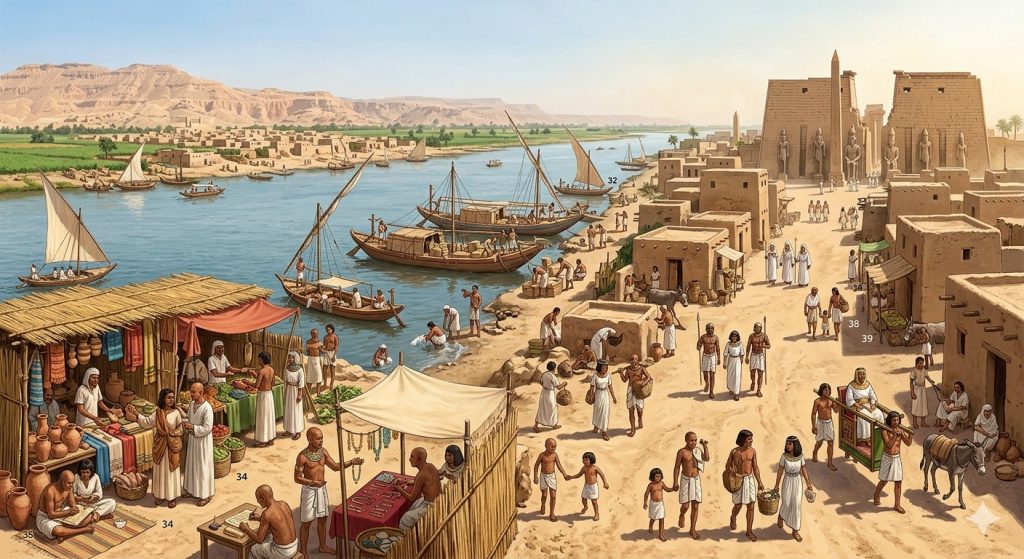
Life in ancient Thebes was shaped by the Nile, religion, agriculture, royal power, trade, craftsmanship, and the large communities that developed around the temples and royal necropolis.
Ancient Thebes: The City Behind Modern Luxor
The ancient city of Thebes developed on both sides of the Nile.
The eastern side was associated with the main urban and temple areas, while the western side became particularly important for royal and private funerary monuments.
This division was not absolute, but the archaeological landscape of Luxor today still reflects the different functions that developed around the river.
Major temples such as Karnak and Luxor Temple were central to the religious life of the city.
Across the river, the west bank became home to royal tombs, private cemeteries, temples, and settlements connected with the funerary landscape.
The Nile and Everyday Life
The Nile was fundamental to life in ancient Egypt.
The river provided water, supported agriculture, enabled transportation, and connected communities throughout the country.
In Thebes, the Nile also connected the eastern city with the monuments and settlements of the west bank.
Boats and river transport played an important role in moving people and goods.
The agricultural landscape surrounding the city depended heavily on the river and its fertile floodplain.
This relationship between the Nile, agriculture, and society is an important part of understanding Ancient Egyptian daily life.
Life Around the Temples
Religion was deeply integrated into life in ancient Thebes.
The city’s temples were not simply places for visitors to worship. They were major religious and economic institutions that required large numbers of priests, craftsmen, administrators, laborers, and other workers.
Karnak Temple grew over many centuries and became one of the most important religious complexes in ancient Egypt.
Luxor Temple was also closely connected with royal and religious traditions.
The temples required ongoing maintenance, construction, decoration, administration, and supplies, creating employment and supporting communities around them.
Workers and Craftsmen in Ancient Thebes
The construction and decoration of temples and tombs required highly skilled workers.
One of the clearest archaeological examples is Deir el-Medina, a settlement associated with the craftsmen who worked on royal tombs in the Theban necropolis.
The remains of the village provide evidence about houses, tools, religious practices, families, and community organization.
This makes the site especially valuable because it allows us to study the people behind the monuments rather than focusing only on kings and temples.
Homes and Neighborhoods
Not everyone in ancient Thebes lived in monumental buildings.
Ordinary houses were generally built using materials such as mudbrick, while stone was more commonly used for major monuments.
Archaeological evidence from settlements such as Deir el-Medina helps researchers understand how homes were organized and how people used domestic spaces.
The remains of houses, pottery, tools, storage areas, and other objects can reveal aspects of household activity and material culture.
Although archaeological evidence is incomplete, it gives us a more realistic picture of ancient communities than the surviving monuments alone.
Agriculture and Food
Agriculture was essential to the economy of ancient Thebes.
The fertile land around the Nile supported the cultivation of crops such as wheat and barley, along with vegetables, fruits, and other agricultural products.
Animals also played an important role in farming and food production.
Tomb paintings and archaeological remains provide evidence for agricultural activities, but these sources need to be interpreted carefully because funerary scenes were created according to specific artistic and religious conventions.
The combination of artwork, archaeological remains, and other evidence helps researchers reconstruct the agricultural economy that supported the population.
Social Life and Entertainment
Ancient Theban society included people from many different social and professional backgrounds.
Officials, priests, craftsmen, farmers, servants, soldiers, merchants, and administrators all contributed to the functioning of the city and its institutions.
Evidence from tombs and settlements suggests that music, celebrations, banquets, and religious festivals were important parts of social and cultural life.
However, surviving evidence is often connected with particular social groups or religious contexts, so it does not necessarily represent the experiences of every person who lived in Thebes.
The West Bank and the World of the Dead
The western side of Thebes became strongly associated with the dead.
It contains some of the most important cemeteries and funerary monuments in Egypt, including the Valley of the Kings, private tombs, and Deir el-Medina.
The concentration of these monuments reflects the importance of funerary traditions in the ancient city.
The tombs were connected with beliefs about the afterlife and included architecture, inscriptions, paintings, and funerary equipment designed to support the deceased.
To understand the wider traditions behind these monuments, see our guide to Ancient Egyptian Mummification & Burial Customs.
What Did People in Ancient Thebes Believe?
Religion influenced many areas of life in ancient Thebes.
The city became particularly associated with the god Amun, whose cult became extremely important during the New Kingdom.
Religious beliefs were reflected in temples, festivals, funerary monuments, household practices, and artistic traditions.
The archaeological remains of Thebes therefore show that religion was not separate from daily life. It was closely connected with government, work, art, architecture, and ideas about death.
Thebes as a Royal City
Thebes became particularly important during the New Kingdom, when it served as a major royal center.
Powerful rulers commissioned temples and monuments throughout the area, contributing to the development of the monumental landscape that visitors see today.
The relationship between the royal court, temples, craftsmen, and administrative institutions helped make Thebes one of the most significant cities in ancient Egypt.
Its importance continued in different forms even after political power shifted elsewhere.
Ancient Egyptian Art in Thebes
The monuments of Luxor preserve an extraordinary amount of ancient Egyptian art.
Tomb paintings and reliefs depict religious scenes, offerings, agricultural activities, animals, officials, and funerary traditions.
Temple walls also preserve inscriptions and reliefs connected with kings, gods, religious ceremonies, and historical events.
These artistic sources are valuable because they provide visual evidence about ancient Egyptian culture, although they must always be interpreted in their historical and religious context.
Our guide to Ancient Egyptian Art explores what these paintings and reliefs can tell us about the civilization that created them.
Why Ancient Luxor Still Matters Today
Modern Luxor is one of the world’s most important archaeological destinations because so much of ancient Thebes remains visible across the landscape.
Visitors can move between temples, tombs, settlements, and archaeological sites and see how different parts of the ancient city were connected.
Rather than viewing each monument as an isolated attraction, understanding ancient Thebes as a living city makes the archaeological landscape much easier to appreciate.
The temples were connected to religious and economic institutions. The west bank was connected to royal and private burial traditions. Settlements such as Deir el-Medina reveal the people who worked within this system.
Together, these sites provide a broader picture of life in one of ancient Egypt’s most important cities.
Experience Ancient Thebes in Luxor
Exploring Luxor with this wider historical context can change the way you experience its monuments.
Instead of seeing the Valley of the Kings simply as a collection of tombs, you can understand its connection with the craftsmen who created them.
Instead of seeing Karnak and Luxor Temple only as impressive monuments, you can understand their role within the religious and institutional life of Thebes.
And instead of viewing ancient Egyptian culture only through the lives of pharaohs, you can look at the workers, families, priests, farmers, craftsmen, and officials who helped make the city function.
Egyptia Tours offers cultural experiences in Luxor designed to connect archaeological sites with the history and people behind them.
Explore Ancient Egyptian Culture
Ancient Thebes was only one part of the much larger civilization that developed along the Nile.
If you want to explore the wider subject, visit our main guide to Ancient Egyptian Culture for an overview of Egyptian society, beliefs, art, heritage, and traditions.
You can also explore our Ancient Egyptian Daily Life & Culture Tour in Luxor, which focuses on archaeological evidence from Deir el-Medina, the Tombs of the Nobles, and other sites connected with ancient life in Luxor.
Leave a Reply
You must be logged in to post a comment.