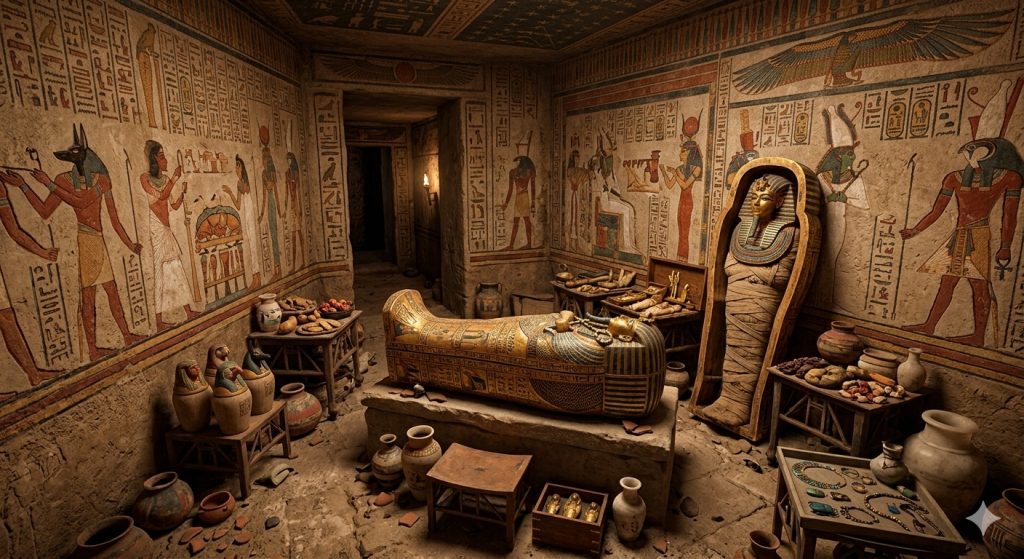
Ancient Egyptian tombs were created to protect the deceased and support their existence in the afterlife. They were not simply places where bodies were buried.
The architecture, inscriptions, paintings, coffins, offerings, and funerary objects found inside tombs were all connected to ancient Egyptian beliefs about death and the next life.
These traditions changed considerably over more than three thousand years of Egyptian history. Different periods, regions, and social groups developed different approaches to burial.
For a broader introduction to these beliefs, see our guide to Ancient Egyptian Culture.
Why Are Ancient Egyptian Tombs Important?
Tombs are among the most valuable sources of archaeological evidence for understanding ancient Egypt.
They can provide information about:
- Religious beliefs
- Burial customs
- Social status
- Art and craftsmanship
- Ancient occupations
- Family relationships
- Daily activities
- Ideas about the afterlife
Some tombs contain scenes of agriculture, fishing, hunting, music, food preparation, and other activities. Others focus more heavily on religious rituals and the journey of the deceased.
This is why tombs can help researchers understand both the beliefs and the society of ancient Egypt.
The Valley of the Kings
The Valley of the Kings is one of the world’s most famous archaeological sites.
Located on the west bank of the Nile at Luxor, the valley became a major royal burial ground during the New Kingdom.
Instead of constructing monumental pyramids for their royal burials, New Kingdom rulers were buried in rock-cut tombs excavated into the surrounding cliffs.
The tombs were designed with corridors and chambers leading deeper into the rock. Many were decorated with religious texts and scenes associated with the king’s journey through the afterlife.
What Can You See Inside the Valley of the Kings?
Depending on which tombs are open and available with your ticket, visitors may see:
- Long decorated corridors
- Burial chambers
- Painted ceilings
- Hieroglyphic inscriptions
- Religious scenes
- Stone sarcophagi
The selection of tombs open to visitors can change, so it is better to treat individual tomb access as subject to current site conditions rather than guaranteeing a particular tomb.
Royal Tombs and the Afterlife
The decoration of royal tombs was strongly connected with the ancient Egyptian understanding of the afterlife.
Walls could contain religious compositions, deities, symbolic scenes, and texts intended to guide and protect the deceased ruler.
The tomb therefore functioned as part of a larger funerary system involving the body, burial equipment, rituals, and beliefs about the continuation of existence after death.
You can learn more about this broader tradition in our article on Ancient Egyptian Mummification & Burial Customs.
Private Tombs of the Nobles
Royal tombs represent only one part of Luxor’s funerary landscape.
The west bank also contains numerous private tombs belonging to officials, administrators, priests, and other members of elite society.
These are often known collectively as the Tombs of the Nobles.
Their decoration can provide a different perspective from the royal tombs. Scenes may show agriculture, food production, hunting, fishing, music, celebrations, servants, and other aspects of society.
Because of this, private tombs are particularly valuable for understanding how ancient Egyptians represented their society and their hopes for the afterlife.
What Do Tomb Paintings Tell Us?
Ancient Egyptian tomb paintings are among the most recognizable forms of Egyptian art.
However, they should not be treated as simple photographs of everyday life.
The scenes were created within religious and cultural conventions and could have symbolic or funerary purposes.
At the same time, they preserve valuable evidence about clothing, tools, agriculture, animals, food production, music, occupations, and social roles.
Our guide to Ancient Egyptian Art looks more closely at what these paintings and reliefs can reveal about ancient Egyptian society.
Deir el-Medina and the Tomb Builders
Another important part of Luxor’s archaeological landscape is Deir el-Medina.
The settlement was home to workers and craftsmen responsible for building and decorating royal tombs in the Theban necropolis.
Unlike the grand royal monuments, Deir el-Medina provides evidence about the community behind them.
The remains of houses, workshops, objects, inscriptions, and nearby tombs help archaeologists reconstruct aspects of the workers’ lives, occupations, families, and beliefs.
Read more about this fascinating community in Deir el-Medina: Life of the Workers Who Built the Royal Tombs.
How Were Ancient Egyptian Tombs Decorated?
Tomb decoration varied according to the period, type of tomb, and status of the deceased.
Common elements could include:
- Painted figures
- Hieroglyphic inscriptions
- Religious texts
- Representations of offerings
- Agricultural scenes
- Funerary rituals
- Images of deities
- Scenes connected with the afterlife
The decoration was not only intended to make the tomb beautiful. Many images and texts had religious meanings and were connected with the deceased’s journey and continued existence.
Tombs, Mummification and Burial
The tomb was only one element of a much larger burial tradition.
The body had to be prepared, funerary rituals performed, and burial equipment provided. The tomb then served as an important place associated with the deceased and their transition into the afterlife.
This connection between the preserved body, funerary rituals, and the tomb is central to understanding Ancient Egyptian Mummification & Burial Customs.
Why Luxor Has So Many Ancient Tombs
Ancient Thebes, modern Luxor, was one of the most important religious and political centers of ancient Egypt.
Its location on both sides of the Nile created a landscape filled with temples, settlements, cemeteries, and royal and private tombs.
The west bank became particularly important for funerary monuments, while major temples were established across the Theban landscape.
This concentration of archaeological remains makes Luxor one of the best places to explore ancient Egyptian burial traditions in their original setting.
Visiting Ancient Egyptian Tombs in Luxor
A visit to Luxor’s tombs can offer a much deeper understanding of ancient Egypt than viewing isolated artifacts in a museum.
At the Valley of the Kings, you can explore royal burial architecture and funerary decoration.
At the Tombs of the Nobles, you can see evidence connected with officials and elite society.
At Deir el-Medina, you can discover the community of craftsmen who created many of the royal tombs.
Together, these sites reveal different sides of ancient Egyptian burial culture.
Explore Ancient Egyptian Tombs With Egyptia Tours
If you want to explore the archaeological evidence of ancient Egyptian burial traditions with a local guide, our Ancient Egyptian Mummification & Burial Culture Tour in Luxor connects the Valley of the Kings with other important sites on Luxor’s west bank.
The exact tombs visited can depend on site access, current opening arrangements, and ticket availability.
Continue Exploring Ancient Egyptian Culture
If you are interested in the wider history behind Luxor’s monuments, explore:
Ancient Egyptian Daily Life — Discover food, work, family life, clothing, and other aspects of everyday life..
Leave a Reply
You must be logged in to post a comment.